• LifeOffLabel’s Pharmacy Saturation Index

    One thing among the many things to consider when choosing a pharmacy school is the extent to which a state is saturated with pharmacy schools. Whether you plan to practice in the same state or move to a different state after graduation, it would be good to know what states are more likely to have their markets flooded with new graduates each year.

    Just looking at the number of pharmacy schools in each state does not tell the whole picture. Some states, like California, have a lot of schools. But they also have a lot of people. So what we really want to know is, how proportional is the number of schools to the state’s population?

    I made a table where I compared the number of pharmacy schools in a state to the state’s population (obtained from 2020 Census data), presented in order from least saturated to most saturated. To get the saturation “index,” I divided the population by the number of schools, and then divided that by 1 million. Therefore, the number represents how many million people exist per school, with a higher number indicating less saturation.

    The formula: (State Population / Number of Schools) / 1,000,000

    A few things to keep in mind:

    • This table does not account for satellite campus locations, only main campus location
    • Several states do not have a pharmacy school (at least a main campus) – VT, NH, AK
    • This map only counts schools, it does not take into account class size

    But, again, we’re just looking at some data for fun, so let’s see what we’ve come up with!

    StatePopulation# CoPAreaPer Pop
    Minnesota5,706,49412251635.706494
    New Jersey9,288,9942225914.644497
    Washington7,705,28121848273.852641
    Florida21,538,18761703043.589698
    Arizona7,151,50222952343.575751
    Michigan10,077,33132504933.35911
    Puerto Rico3,285,874191043.285874
    Utah3,271,61612196533.271616
    Texas29,145,50596962413.238389
    Nevada3,104,61412863803.104614
    Missouri6,154,91321815333.077457
    Kansas2,937,88012131002.93788
    Colorado5,773,71422698372.886857
    Georgia10,711,90841539092.677977
    North Carolina10,439,38841393902.609847
    New York20,201,24981413002.525156
    Alabama5,024,27921357652.51214
    California39,538,223164239702.471139
    Louisiana4,657,75721353822.328879
    Indiana6,785,5283943212.261843
    Kentucky4,505,83621046592.252918
    Oregon4,237,25622550262.118628
    New Mexico2,117,52213151942.117522
    Maryland6,165,1293321312.055043
    Oklahoma3,959,35321811951.979677
    Wisconsin5,893,71831696401.964573
    Pennsylvania13,002,70071192831.857529
    Idaho1,839,10612166991.839106
    Illinois12,812,50871499981.830358
    Connecticut3,605,9442143571.802972
    Massachusetts7,029,9174273361.757479
    Virginia8,631,39351108621.726279
    Ohio11,799,44871160961.685635
    Iowa3,190,36921457461.595185
    Arkansas3,011,52421377331.505762
    Mississippi2,961,27921254431.48064
    Hawaii1,455,2711283111.455271
    South Carolina5,118,4254829311.279606
    Tennessee6,910,84061092471.151807
    Rhode Island1,097,379131441.097379
    Montana1,084,22513811541.084225
    Nebraska1,961,50422005200.980752
    South Dakota886,66711997290.886667
    North Dakota779,09411831080.779094
    Washington, D.C.689,54511770.689545
    Maine1,362,3592916460.68118
    West Virginia1,793,7163627550.597905
    Wyoming576,85112533480.576851

    Creating a Heat Map

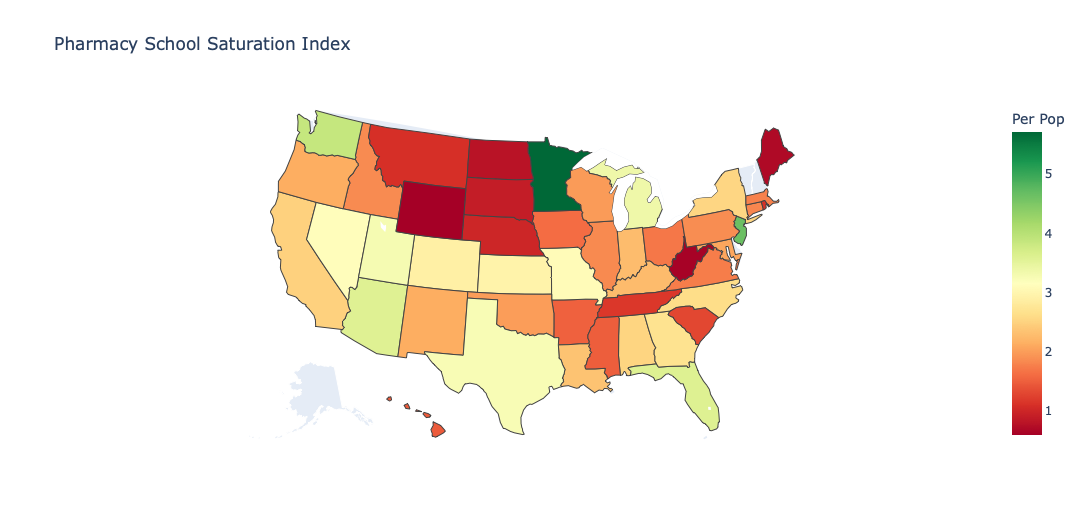
    As informative as the above table is, I think it helps when we have some visual cues. I took the above results and created a heat map where green = less saturated and red = more saturated.

    (I recently started learning Python, so I’m pretty proud of how this turned out!)
    Looking Ahead

    To see how this may play out in the future, I also looked at HRSA’s 2031 workforce projections for pharmacists. Nationally, there is expected to be shortage of about 18,000 pharmacists. However, this will be felt in some states more than others. Of the top 5 most saturated states (according to my index), North Dakota, West Virginia, Washington DC, and Wyoming are also projected to have a surplus of pharmacists by 2031. Of the top 5 least saturated states, Washington and Florida are also projected to have a shortage. Of course, this assumes no new schools open in that time, but it appears the trend of pharmacy schools constantly opening has slowed significantly from where it used to be 10-20 years ago.

    To what extent does my saturation index correspond to a shortage in 5 years? Let’s look at that, too.
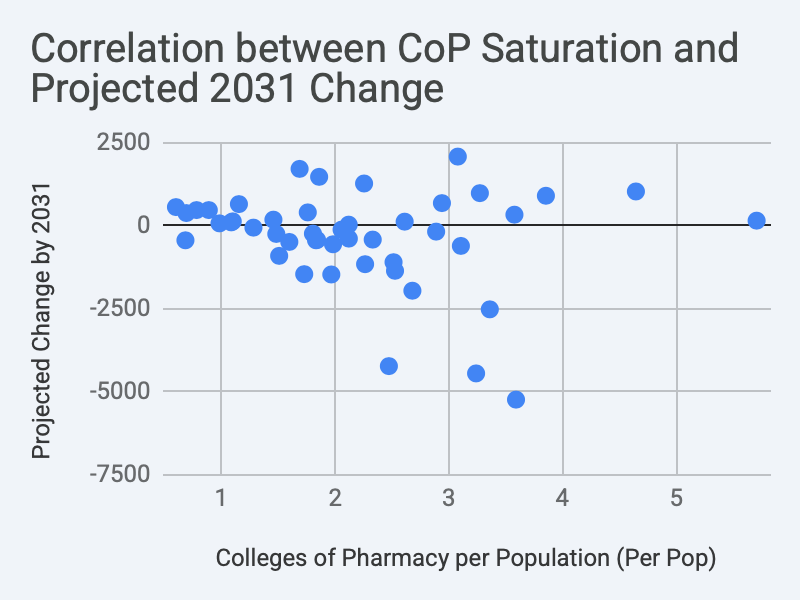
    It’s not as compelling as we were hoping. As we can see, any correlation between my saturation index and future workforce projections is quite weak. I’ll definitely need to do some more investigating and data gathering to see if I can make my index stronger. Probably class size will be a good one to incorporate if I am able. But that will be for another post!
  • Bathroom Theory

    Businesses spend a lot of money on sleek logos, fancy lobby furniture, and crafting the perfect mission statement to tell you who they are. I’m sure those things are important, but as someone with a tiny bladder, I’ve had extensive exposure to the different bathrooms of America. I’ve become a bit of a connoisseur of the Haus of Porcelain Throne, which has led me to a theory: 

    You can tell a lot about a business by how well they take care of their bathrooms.

    If well-maintained, the business is likely paying attention to the details in all aspects of the business. If neglected, what else is the business neglecting?

    Case Study #1: Buc-ees

    Buc-ees is known for many things, but one of their biggest draws is their large and always-clean bathrooms. Everything really is bigger in Texas. There are several things about the way Buc-ees approaches their bathrooms that actually hint at good business practices.

    1. Respect for dignity: Most public restrooms have those awkward gaps in the stall doors that make eye contact a constant threat. Buc-ee’s invested more money than a typical business does to surround each of their 6,423 stalls with floor-to-ceiling walls and heavy-duty doors. It shows a level of respect toward their customers by doing more to ensure privacy.
    2. Dedicated bathroom crew: You almost never walk into a Buc-ee’s restroom without seeing an employee actively cleaning. They don’t just have a “check sheet” on the back of the door that some employee initials off (if at all) and they also pay them pretty well. It shows that they treat maintenance as a primary function of the business, not a secondary chore for an overworked cashier. Plus, when the dispensers are always full and the toilet paper always stocked, you prevented less frustrations among your customers.
    3. Green lights: Many locations have the red and green lights above the stalls to indicate whether the bathroom is occupied. It’s essentially a high-stakes parking garage for your dignity that eliminates awkward glancing under the doors, knocking, or jiggling handles.
    4. Location, location, location: Usually, putting the restrooms at the back of the store is a cheap retail trick to force you past the merchandise. But at Buc-ee’s, the location is a flex. They know you’ve been holding it for 40 more miles specifically because you trust their stalls more than your own home’s. Walking past the brisket smells and wall of ICEE machines isn’t a chore; it’s the appetizer. They’ve turned a basic human necessity into a destination event that justifies a five-minute hike through a sea of Beaver Nuggets.

    Buc-ee’s didn’t just build a bathroom. They built an example of operational excellence.

    Case Study #2: The Sketchy Gas Station Bathroom

    Many gas stations treat the bathroom as a liability to be managed, not a service to be provided. These are the bathrooms you only go to because you absolutely have to. They are dirty, may be out of supplies, smelly, and you’re just hoping to come out of the experience as disease-free as you were when you entered. Here are some things it can also say about the business:

    1. Uninviting: When you have to ask a teenager behind a bulletproof glass window for a key attached to a 5-pound piece of scrap metal, it definitely doesn’t come across as inviting. What they fail to realize is that it also doesn’t invite me to make any other purchases.
    2. Neglected maintenance: A flickering fluorescent light, unstacked supplies, or a door that doesn’t quite lock signal that the business does not care about maintenance. Sure, it’s “just the bathroom,” but neglect is rarely contained to one room. If they’ve stopped caring about the lightbulbs you can see, what else is being neglected behind the scenes? Can you really trust they’re checking the expiration dates on the things you’re about to eat?
    3. Single-ply experience: If a business is trying to save $0.002 per visitor by using translucent toilet paper, you have to wonder where else they are cutting corners. Are they also skimping on safety protocols? Fresh ingredients? Proper training? If they are willing to save a few cents on two-ply or a functional latch, you can bet they are looking for ways to cut corners on your experience, too.

    What Makes a Good Bathroom/Business?

    Failing to invest in things that can make an experience better for the customer signals that money is the only bottom line. But here’s the irony: the businesses that treat the bathroom like an afterthought usually end up losing the very thing they’re chasing. When a customer walks out of a neglected restroom, they aren’t just thinking about the soap; they’re recalculating the value of the entire brand.

    And this is why I think bathroom theory works. It’s not just about the bathrooms, but any part of a business that may be overlooked because the leaders don’t see it as a core part of their business. It could instead be the janky website that hasn’t been updated in a decade. Perhaps it’s a lack of transparent pricing. Or maybe it actually is the furniture in the lobby. But these are all things your customers see and relate back to your business. In the end, a business that doesn’t respect the small, unglamorous needs of its customers doesn’t actually respect the customer. When a company excels at something they could easily ignore, they are revealing their true character.

  • What Actually IS Associated with NAPLEX Pass Rates? (Part 2)

    In Part 1, we looked at individual factors like school age and ranking to see how they correlated with NAPLEX pass rates. The scatter plots gave us a good “vibe check,” but they left us with a major question: Which of these factors are actually driving the results, and which are just along for the ride?

    To find out, we have to move beyond simple observations and perform a multivariable linear regression. Think of this like a clinical trial for data. In a trial, we want to know if a drug works independently of a patient’s age, weight, or other medications. In our regression, we are doing the same thing, but instead of randomizing pharmacy students into two groups, we are statistically adjusting for the other variables all at once to see which ones remain statistically significant. It allows us to isolate the impact of a single factor while holding everything else constant.

    It’s time to find out which variables are the true “active ingredients” in a school’s success rate and which ones are just “excipients” in the formula.

    Testing the Formula

    95% Confidence Interval
    PredictorEstimateSELowerUppertp
    Interceptᵃ103.54555.369792.9238114.167319.283<.001
    Program Age-0.01380.0217-0.05670.0291-0.637.525
    1st attempts-0.03640.0255-0.08680.0140-1.428.156
    USN Rank-0.28370.0388-0.3604-0.2070-7.315<.001
    R Tier nomiss:      
    1 – 0-5.64422.6468-10.8798-0.4087-2.133.035
    2 – 0-0.32252.7180-5.69915.0540-0.119.906
    4 Years:      
    1 – 0-3.36472.2686-7.85221.1228-1.483.140
    ᵃ Represents reference level

    So what are we actually looking at? When we throw all of our variables into the mortar together, something fascinating happens: Once we account for everything else, the US News Rank was the only factor that remained statistically associated with higher pass rates. Most of the other variables lost their statistical significance. But here is the real head-scratcher: Programs affiliated with Tier 1 research universities were actually associated with lower pass rates.

    But Laura, how can this be? In Part 1, the Tier 1 schools were the ones with the high scores!

    This is the beauty (and chaos) of regression.

    Tier 1 schools and high rankings are kind of like best friends. They almost always show up to the party together. Because our model already accounted for the rank, we are essentially asking a very specific question: “If we have two schools with the exact same rank, but one is part of a tier 1 research powerhouse and the other is not… which one has the higher pass rate?” The data suggests that, all other things being equal, the non-research institution actually comes out on top.

    The Overlap: Research vs. Rank

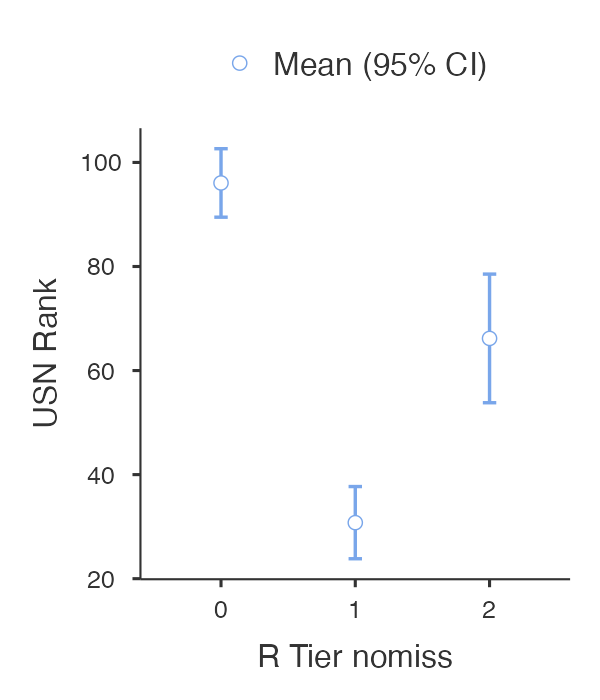
    This isn’t magic; it’s just how the “prestige” system is built. This graph highlights just how much rank and research status coincide.

    A program affiliated with a tier 1 university has a mean rank of about 31. For tier 2, that number drops to 66, and for the rest, it slides down to 96 (p<0.001). They are so intertwined that it’s easy to give the credit to the research tier when it actually appears to belong to the rank.

    Testing Collinearity

    Are they so intertwined that they are affecting the model? It would be good to check. We can look at collinearity statistics, which are presented in the table below. the VIF is telling us how crowded the party is, or how much one variable might be overlapping with a neighbor variable. Ideally, we want that to be under 2, which is how all of them fall in this model. The other piece is tolerance, which looks at how much the variables are independent of each other. This is important because one of the big assumptions made when building a regression model is that the variables are independent. Ideally, we want these to be above 0.5, and we can see that they are in this model.

     VIFTolerance
    Program Age1.550.646
    1st attempts1.210.825
    USN Rank1.950.514
    R Tier nomiss1.250.802
    4 Years1.150.873

    There are some other diagnostic tests of the model that I looked at to see whether it was a good fit, but I won’t bore you with those details (at least this time). Just know that we’ve built a pretty good model.

    Real-World Projections

    How do these results translate into the real world? Projecting this data forward, this table highlights how a few different ranks would correspond to pass rates based on the regression results. A drop of around 40 points in rank is associated with an almost 10% decrease in pass rates.

    95% Confidence Interval
    USN RankMarginal MeanSELowerUpper
    28.0⁻88.22.0184.392.2
    68.0μ76.91.1974.579.2
    108.0⁺65.51.9061.869.3
    Note. ⁻ mean – 1SD, μ mean, ⁺ mean + 1SD

    Takeaways

    I know this might ruffle some feathers with the “rankings don’t matter” crowd in the pharmacy world. I realize that a single model can’t capture the entirety of a student’s experience or potential. This analysis was a “pet project” meant to satisfy my own curiosity, not a definitive judgment on any single institution. Choosing a pharmacy program is a deeply personal decision involving many factors such as location, cost, culture, and clinical opportunities. However, all else being equal, this and some of the other factors from part 1 may be worth considering for a prospective pharmacy student trying to narrow it down to one program.

    I also hope this made statistics a little bit less scary. Whether it’s analyzing national board rates or just tracking your own “off-label” hobbies, data can hold new insights to things you might already be asking yourself, and the real fun is in uncovering some answers.

  • What Actually IS Associated With NAPLEX Pass Rates? (Part 1)

    Historically, admission into pharmacy school was more selective and most students could feel confident in passing the NAPLEX no matter where they enrolled. However, the landscape has shifted. We’ve seen a rapid expansion in the number of pharmacy programs set against a sharp decline in the applicant pool. From the 2022-2023 application cycle, PharmCAS reported that 86.8% of applicants were accepted to a pharmacy program, significantly up from the 30-50% range 15-20 years ago. At the same time, NAPLEX pass rates are also declining, down to 74.3% in 2024 from 85.8% in 2020.

    As a data nerd, I decided to analyze specific school attributes to see how they actually correlate with NAPLEX first-time pass rates. My goal is to provide a data-driven look at which factors truly influence your chances of passing the NAPLEX on the first try. I also want to show that data analysis and statistics doesn’t have to boring, and maybe even a little fun!

    The Data

    I made a data set from information available to me from PharmCAS, NABP, and pharmacy school websites. I compiled the type of program (public or private), program length (traditional 4-year vs. others), the age of the program (in years, as of 2024), class size (based on number of first attempts), and whether the program is part of a tier 1 or tier 2 research university to see if any of that could provide me with some insight on a program’s percentage of students who pass the NAPLEX on the first try.

    One disclaimer: The pass rate data is from 2024, which means many students were enrolled during the COVID-19 pandemic. At some point I might find the time to update my data with 2025, especially since the mean pass rate came up that year, but let’s see what we can find with this anyway.

    Visualizing Variables

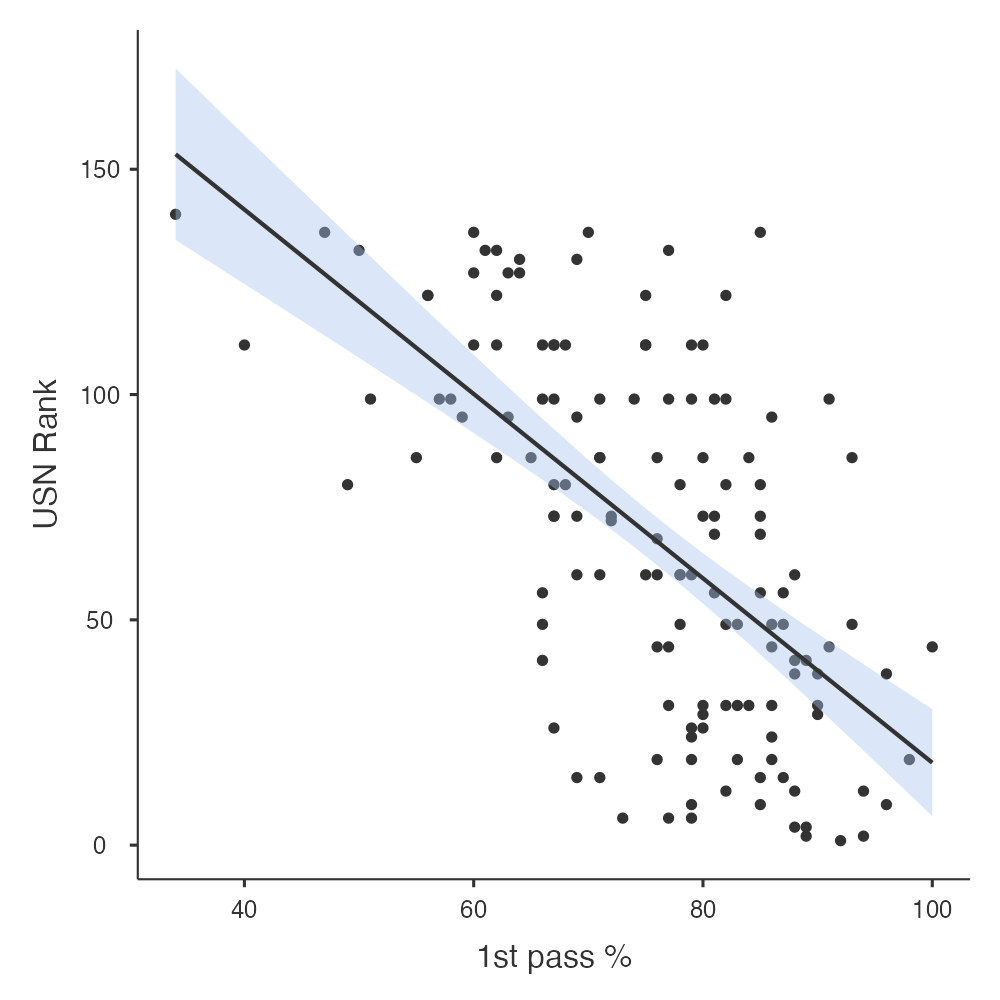
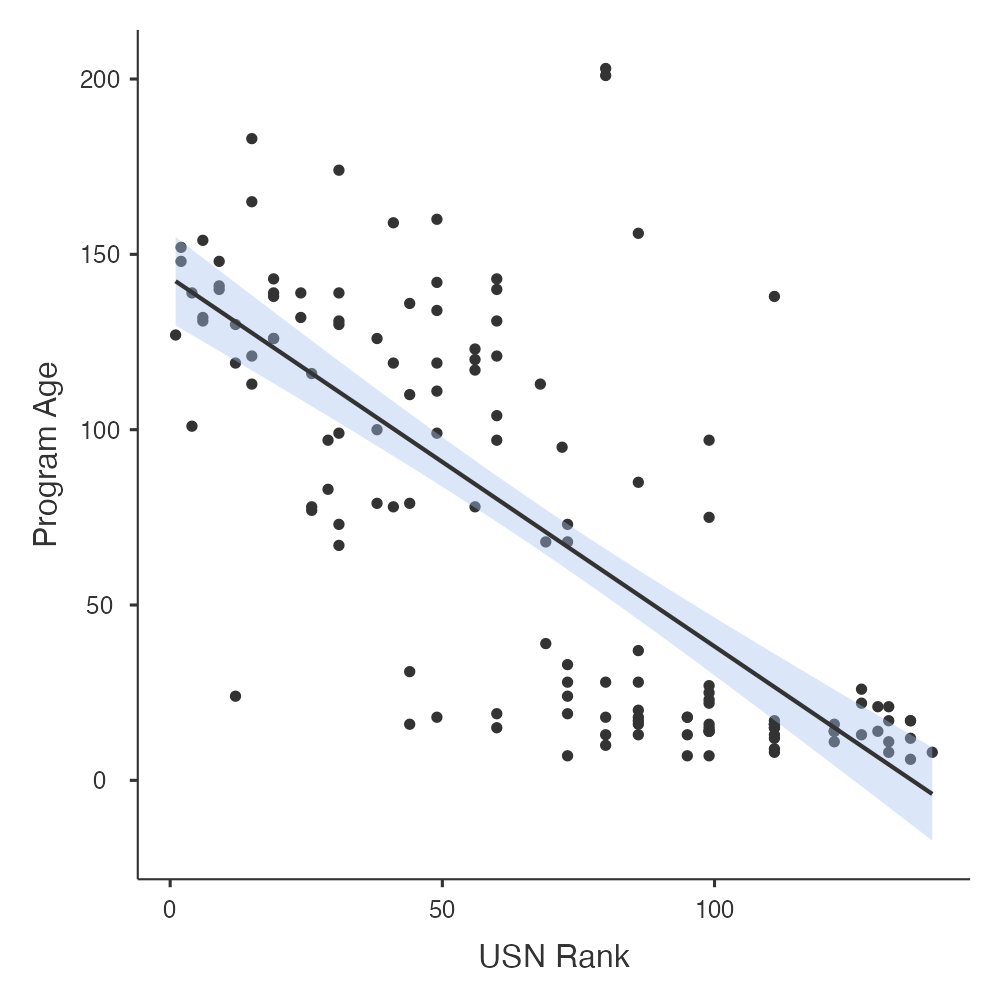
    I thought it might be fun to just explore some scatter plots and descriptive statistics. Right off the bat, it looks like there might be some correlation between a lower US News ranking (higher number) and lower pass rates.

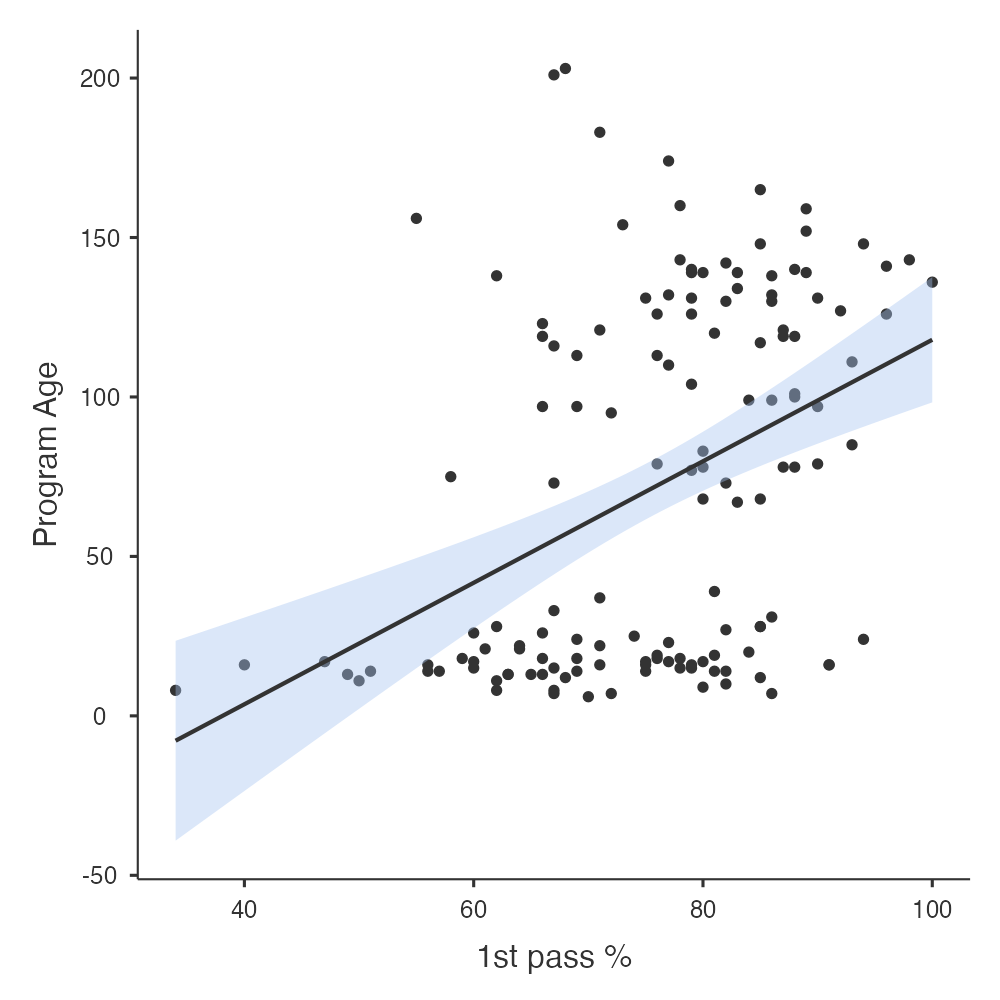
    Next, I looked at the program age. There also appears to be some correlation between the age of the program (with older programs being a higher number) and first time pass rate.

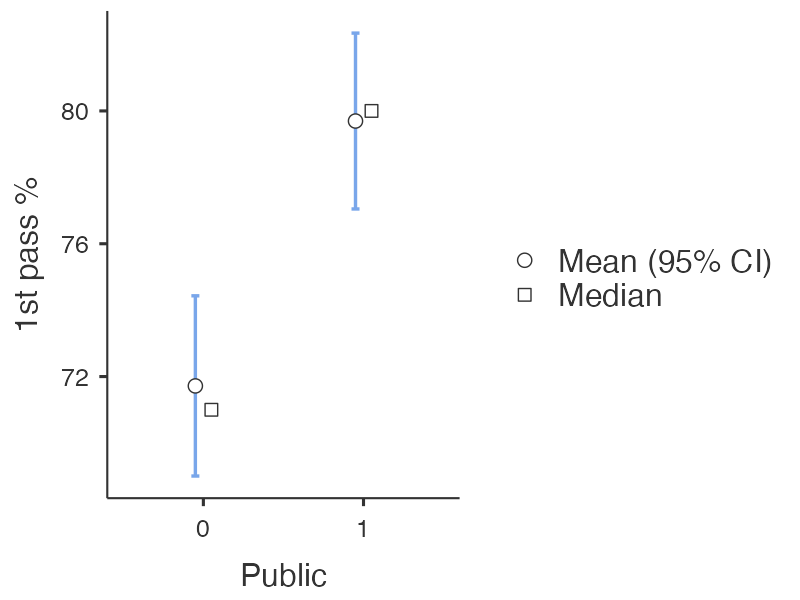
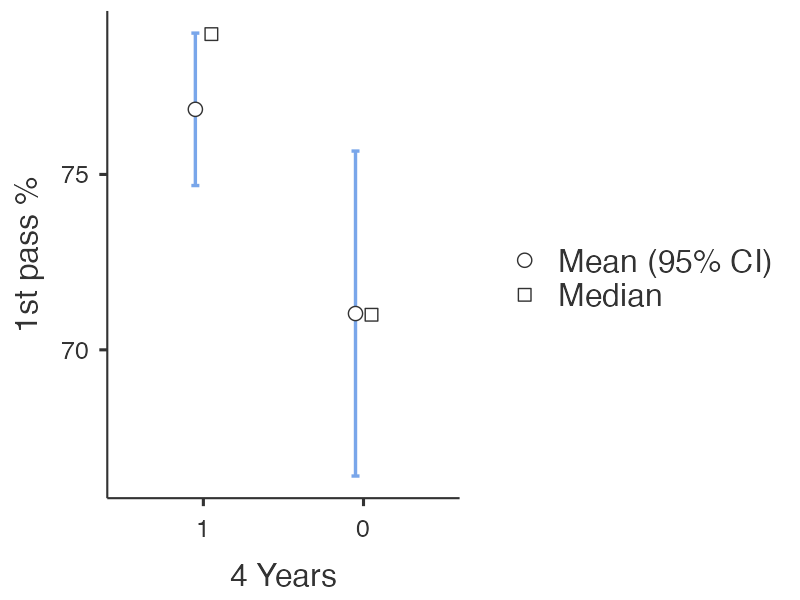
    Some other interesting insights with the binary data: public institutions have a higher mean pass score relative to private institutions (80% vs. 72%, p<0.001) and 4-year programs have a higher mean pass score than other types of program lengths (77% vs. 71%, p=0.02).

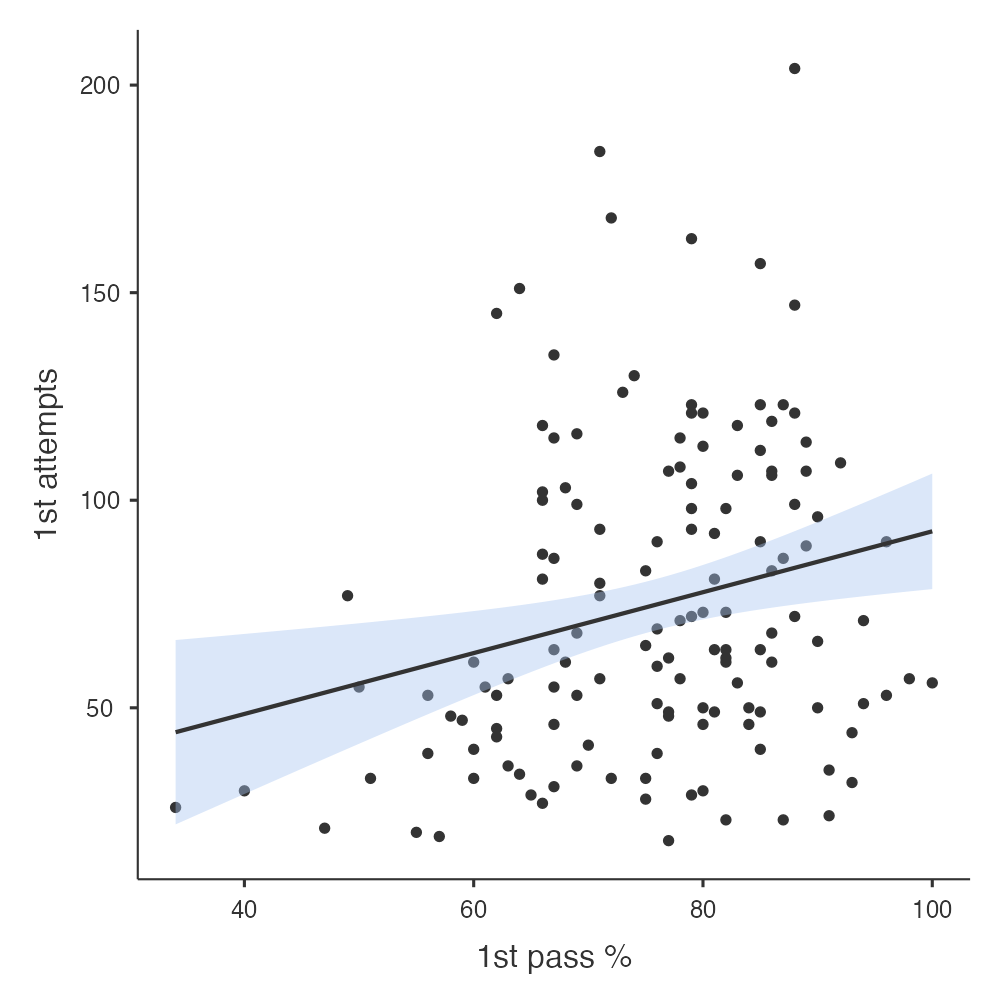
    Additionally, there appears to be some correlation between class size and pass rate (larger classes have higher pass rates) and between the age of the program and rank (older programs tend to be ranked higher).

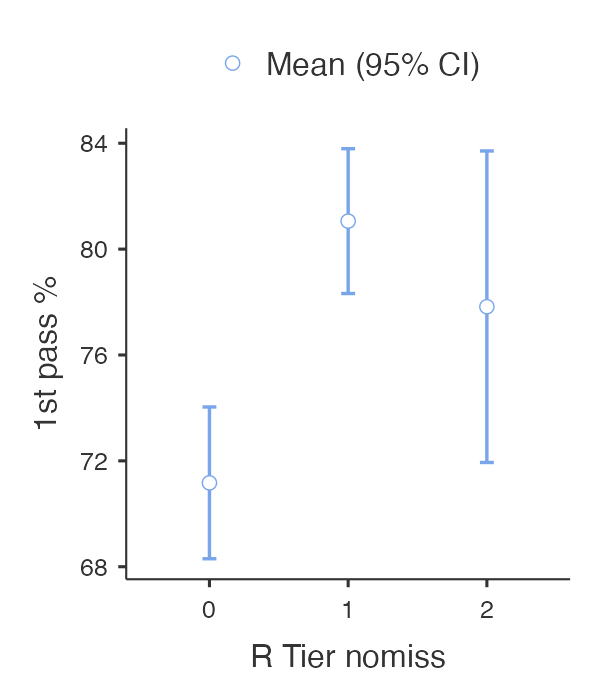
    Programs that are affiliated with tier 1 and tier 2 research institutions also tend to have higher mean pass rates than those that are not (81% for tier 1, 78% for tier 2, and 71% for others, p<0.001).

    Mystery Solved?

    On first glance, it looks like programs that are older, public, 4 years, and have a higher US News ranking are more likely to provide more of their graduates with a successful first-time pass rate. While these scatter plots show us a correlation, they don’t necessarily tell us the whole truth. For example: Does the 4-year structure actually help, or do those schools just happen to be the ones with higher research tiers or ranks? Does a school’s rank actually predict pass rates, or is the ranking just reflecting the fact that those schools are mostly large, public universities? When we account for the age of the program, do private schools actually perform differently than public ones, or are the lower pass rates we see just a symptom of being newer schools?

    In Part 2, we will dive into some more robust analyses. I’ll share the results of a multiple linear regression to see which of these factors actually holds weight when we control for the others. We’ll also look at some diagnostics to make sure our model isn’t just hallucinating patterns (a little thing called collinearity). Stay tuned!

  • Not All Who Wander Have Lost Their Focus (Maybe They Just Have ADHD)

    The last time I regularly posted here, I was a pharmacy student just trying to survive the next exam. At the time, this blog was a way to process the stress of school and find some semblance of balance.

    If you’ve been away for a while (like I have), a lot has happened.

    I didn’t just finish pharmacy school. I kept going. added a PhD to my PharmD, moved from “student” to “pharmacist” to “researcher,” and traded my study guides for data sets. On a personal level, I got married and became a mother. By all accounts, I’ve “arrived” at the professional goals I was dreaming about back in those early pharmacy school posts. Oh, but then another thing happened. I also got diagnosed with ADHD later in life. And as any ADHD brain knows, “arriving” doesn’t mean the wandering stops.

    I’ve realized that while my identity is deeply rooted in being a pharmacist and a scientist, I still need a sandbox. I need a place where I don’t have to be “Dr.” or “mom” for a second. A place to explore the hyper-fixations, the creative side-quests, and the data-driven curiosities that don’t always fit into a HEOR study or a bedtime story.

    I’m calling this my “off-label” life. In the medical world, off-label use is about taking something established and finding a new, unexpected purpose for it. That’s what I’m doing here. I’m taking the analytical, curious, and admittedly scatter-brained parts of my personality and giving them a home again.

    I’m not sure exactly what this blog will look like this time around. It might be a deep dive into a new hobby, a reflection on neurodiversity in the workplace, or just a snapshot of life as a double-doctorate parent. Whatever it is, I’m glad to be back. It’s been a long time, but I think the best parts of the story are just starting.

  • Being a 5’10 female, I often get asked if I ever played basketball. I always want to be one to shatter stereotypes, but it is true.

    When I was younger, I really got into basketball. I mean REALLY. Living in Illinois at the time, I got to grow up watching and idolizing Michael Jordan. Like Mike, I found a true love for basketball. I could play all day, and often did. I was on many different teams and went to a few basketball camps. Like Mike, my dad played a huge role in my development as a basketball player. He built the basketball goal that still sits in the driveway of my childhood home, and at that goal he’s played me in countless games of one-on-one. Even though he had a four hour round-trip commute to work, he somehow still found the time and energy to help coach some of my basketball teams. I never enjoyed something so much, and my competitive side wanted me to be so good at it. Like Mike, I wanted to be a professional basketball player.

    Unfortunately, that flame for basketball started to flicker. After I moved to Texas, I had some coaches that were great at sucking all the fun from something I used to love so much. When it came time to sign up for high school classes, the block schedule forced me to choose between basketball and band. I also started to really enjoy playing percussion by that point. It was a tough decision, but like a true nerd, I went with band in high school.

    I had a lot of fun on drumline, and I still love playing the occasional basketball game for fun, but for a long time a part of me felt like I failed at my dream. I wanted to be just like Mike, and I quit.

    But since then I’ve learned my life has new dreams, and there’s nothing wrong with that. And best of all, I can still be like Mike. One of my favorite quotes by him came from his Hall of Fame speech. He said, “Limits, like fears, are often just an illusion.” I try to remind myself of that all the time, and it’s inspired me to go out of my comfort zone and try new things I may not have tried before, such as running for officer positions in student organizations. I used to quit things easily because I failed the first time I tried something. And then I remember: The greatest basketball player of all time was once cut from his high school basketball team. Obviously he didn’t let that get to him, and I shouldn’t let myself feel so put down over something I don’t succeed at the first time either. Most of all, Mike has taught me to do what you love, whatever it may be. You won’t find any reward in doing something you aren’t passionate about.

    So, even though I may not have become the best basketball player in the WNBA, I still wanna be like Mike.

  • Whatever it is you do.

    I know that in some fields it’s easier to do than others. It’s easy for me to see that if I make a mistake in a pharmacy, the consequences could be detrimental, and even life-threatening. And that’s what will always keep me on my toes. But for some, say the person working in a call center or the person standing at a cash register day in and day out, it’s not always easy to see why your job matters so much and who it makes an impact on.

    But I want to remind you that no matter how insignificant you may feel, the consequences of every action you take ripple out and will ultimately impact someone. You may not notice it, but it does.

    The other day, I was driving from Oklahoma City to Fort Worth, a three-hour drive that I’ve taken many times before, but this particular time my car battery light came on, my check engine light came on, and my car started slowing down while I was driving on the highway. I’ll later find out that one of my belts broke, but at the time I knew I was in a situation where my car would no longer be drivable in a few seconds. I pulled over to the side of the road, and called Allstate’s Roadside Assistance for a tow truck. While on the phone, the lady on the other line (we’ll call her Betty) called a towing company for me, gave me the phone number to call them in case I needed it, and told me I should expect them within an hour.

    So, there I sat. An hour passes and I don’t see a tow truck, but I give them the benefit of the doubt. After about an hour and a half, I call the towing company to confirm someone is on the way and make sure they didn’t get lost, and they inform me that Betty hadn’t faxed them any of my information, so they didn’t know where to get me. I’d have to call Allstate back to make sure the information gets sent to them, and I gave the towing company my location so someone could be on their way. I ended up waiting a total of three hours for a tow truck thanks to Betty’s mistake. An already stressful situation was made a lot worse, especially considering it was the middle of a summer day in the south and, as my luck would have it, one of the few times I didn’t have a bottle of water with me.

    I try not to blame Betty too much. I get that honest mistakes happen. I also get that it’s hard for someone to feel a lot of sympathy for a mere voice on the other end of a phone call while sitting in a cubicle, making about $10 an hour, with problems of their own in life to deal with. But I wish more of the Betty’s of the world realized that the care they put into their job is just as important as the care a surgeon or scientist puts into theirs. Had the engineer who designed my car parts done a better job the situation could have been avoided altogether. Had the towing company called Allstate right away when they didn’t receive a fax, I could have been helped sooner. Had the sheriff who drove right by made a quick stop to make sure I was okay, I wouldn’t have felt so worried about sitting there for so long in the heat. We all rely on each other, and it’s important for all of us not to forget that.

  • If there’s one thing I wish they had stricter criteria on for pharmacy applicants, it’s pharmacy experience. Most people in my class do have some to an extent, but it always amazes me when a classmate tells me they haven’t even so much as shadowed a pharmacist before pharmacy school. Usually they have amazing grades, PCAT scores, and other extracurricular activities to make up for it, but at the end of the day there’s no substitute for pharmacy experience.

    Back when I was thinking about PA school, one of the things that held me back was a lack of patient contact experience. Most schools require a minimum of 1000 hours before you apply. Considering that a PA is a second career for many people, and consequently most of your competition is full-time nurses, EMTs, anesthesia techs, and the like, 1000 hours isn’t even that much. Why do they require so much? Because it’s a very patient-oriented field and they want to know you’re completely comfortable with it. Ultimately I realized I didn’t want that much patient contact, but I’m glad I hadn’t spent time in PA school before realizing it.

    On the same note, pharmacy school should require a certain number of hours in a pharmacy for applicants. It can be through volunteering, shadowing, or working as a pharmacy tech. It can be in the setting of the applicant’s choice, be it retail, hospital, compounding, etc. But it should be something.

    For starters, if everyone has a certain amount of experience, We wouldn’t have as much of a need for so many IPPE hours, or we could at least be trusted to do more at our sites. I don’t know what kind of impression other P1s left before me, but every time I went to a new site, it seemed like the preceptor would assume I just randomly woke up one morning and decided to go to pharmacy school without actually setting foot in a pharmacy. And maybe that’s how it is for some students, but personally I don’t need an extensive tour of every single pharmacy I go to, as if their way of arranging the drugs is SO different from another pharmacy that I couldn’t figure it out. Nor do I need to sit there and watch everyone work as they try explaining to me what drug classes are, or how to count pills, or how to choose which size container to use. If there’s one thing I hate, it’s standing around when I know I could be doing something. So I’ve learned to bring up my past experience from the start, so my preceptor can start trusting me with more responsibilities at the site and I can actually learn something.

    More importantly, however, pharmacy school is a four-year and very large financial commitment, and it’s important to know the pros and cons before getting into it. A couple posts ago, when I talked about the cynics, it was inspired by coworkers from my past job who would constantly complain about pharmacy at lunch. The nurses suck. The management sucks. The techs suck. The job saturation sucks. Robots are taking over the world, but it starts with pharmacy. Yadda yadda yadda. Every. Single. Day. And yet, I’m still so happy to be in pharmacy school and excited about being a pharmacist. It didn’t deter me from applying, and even the bashing I hear from coworkers now is not going to stop me from continuing through until graduation. I know what I’m getting into, and still see the benefit in it.

    What I’ve come to realize though, is that most people apply to pharmacy school without knowing the common complaints. For example, I’ve already seen several people surprised that pharmacists don’t always work steady schedules. Well, I don’t know what made you think patients only needed their drugs between 8am and 5pm, but sorry if you were misled. I’ve already dealt with the unsteady schedule, working holidays, and up to 14-hour shifts, and even though some pharmacists do have a steady schedule, I don’t mind if mine’s not, so that’s one “con” I’m okay with. Some also didn’t realize how much the job outlook slowed down. A few years ago, people were getting cash bonuses just to work for chains, now those same chains in a lot of cities are only offering part-time floating positions. Yes, the job market is more competitive, but so is any field in this economy. I don’t mind competition, and can see other areas where pharmacy will eventually grow, so that’s another “con” I’m okay with. A few others are just now realizing that their cliche passion to “help people” includes ALL people, including some of the most unappreciative and rude human beings to ever grace the planet, and are unsure if they still want a job that deals with others so often. I know how to shrug people off, so that’s another “con” I can live with.

    So, neeedless to say, some classmates are already questioning their decision and looking at other fields, and it sucks that they’re realizing it after a year of pharmacy school. It makes sense why some didn’t put much thought into it before, because as pre-pharms all we ever heard from the representatives of pharmacy schools was how pharmacy is so awesome. And pharmacy is awesome. You get to serve others and matter to patients, you usually work only 40 hour weeks, you get great pay and benefits, and its a very respectable profession. But it’s not perfect, and it takes getting out into the real world of working pharmacists to discover those imperfections and see if it’s something you still want to pursue.

  • Social media has revolutionized how we interact in many ways, but one of the biggest might be how much we constantly know each others’ business. I’m not complaining, as it’s something I’ve come to accept. When I share things on my Facebook, they are generally things directed to a certain group of people, but I don’t mind that everyone else can see it because I’m too lazy to go through the hassle of limiting everything for possible individual circumstances. If there was something I really didn’t want someone to see, even if they aren’t on my friends list, I just wouldn’t post it. I treat my relatively “private” profile as if anyone could see it, because in reality I have no control over someone on my friends list getting on a computer and showing someone not on my friends list something on my page. I doubt it happens often, but nevertheless it’s a possibility.

    When it comes to having a blog, I have to be even more careful because it is more available to anyone and everyone. When you also throw in the fact that this blog has a professional theme, I really have to watch what I say because I could possibly jeopardize my future reputation as a pharmacist. Words are powerful. It can be a great tool to provide a loud voice in your profession, but it can also come back to bite you. All it takes is one person to take something the wrong way, even if you didn’t intend for your thoughts to come across that way.

    I’m going to inevitably say something that someone doesn’t agree with. I can’t please everyone, and even within this profession, people constantly argue over various things. I just hope most people remember that “pharmacy student” is only a small part of who I am. I don’t want to be afraid of being myself to the extent that you can’t see the individual behind the words. Though I strive to have a higher standard for how I conduct myself than the general population, at the end of the day I’m still human. I don’t always take things seriously, I’m quirky, and I have flaws. Pharmacy school is one of those key times in my life where I’m going to learn a lot and experience many new things, and I can learn a lot about myself by going back through old entries and seeing how my perspective has changed. I’d rather go back to read something and go, “Wow… I was silly!” than have nothing to reflect on at all.

    I have many different interests and talents outside the world of pharmacy, and some of those might entail things that don’t involve being very professional. Though I may have some funny drunk pictures on Facebook, or the mouth of a sailor in reaction to a sports game on my Twitter feed, I would never let those traits overlap into how I function in a pharmacy setting. As long as I can keep my work and play time separate, I don’t see the harm. As pharmacists, we’re supposed to have great social skills and be able to interact well with others, and I don’t see how upholding some uptight professional attitude in all walks of life will do that. It’s not who I am, and if you don’t like it, feel free to take your prescription to the robot at Walgreens.

  • You know who they are. They’re why your two-hour road trip feels like eight. They’re why you don’t watch sports with certain friends. They’re the buzzkills of life. They’re everywhere, and the world of pharmacy isn’t immune to them.

    But here’s the thing… the ones in pharmacy are the ones who have the least to complain about. Yes, I’m calling you out, you middle-aged doom and gloom party poopers. You only had to get a bachelors degree, you graduated with FAR less debt, and you still get to ride the six-figure salary train with the rest of us. When the PharmD was standardized, nobody said you had to go back to school. You got to enjoy the fruits of increased wages and bonuses during the shortage, and now that things have died down a bit you think things are heading for the worst.

    I mean, do you know how many bachelor degrees pay six figures? Not many. Even if your job was heaving piles of cow manure into a fan that only splatters it back in your face, you should be happy because you’re making six figures with a friggin’ bachelors degree. You know what I was doing with my bachelors degree? Working as a pharmacy tech. Does that sounds pathetic to you? I have friends with bachelors degrees that have even worse jobs with worse pay. And in this economy, we’re all supposed to sit here and pat ourselves on the back for even having a job at all.

    So, sorry if I can’t really empathize with all of your complaints. You sound like that spoiled kid in high school who thinks it’s weird that not everyone’s parents can buy them a car. You don’t really know how bad it is for others.

    The younger generation of students and pharmacists are going through a minimum of six, but more often 8 or more years of school to get our PharmDs. Most of us will also graduate with a lot of student loan debt, many in the six-figure range, so even though we’ll be making the same good money as our elders, it won’t seem like as much when we’re putting away so much of our paychecks to pay our loans back. Yet we don’t seem to be complaining so much.

    Maybe it’s because my generation has a different perspective. Pharmacy has its own issues, especially on the retail side of things, but no job is perfect. Personally, I’m glad I’ve worked those crappy grocery store jobs all those years in high school and undergrad, because it gave me such an appreciation for pharmacy. Many jobs have difficult customers, lazy coworkers, stressful situations, cranky bosses, etc. But how many do you get to be so important and get paid so well for doing it? Not many, but pharmacy is one of them.

    Perhaps knowing the obstacles we face, we’re more willing to look to the different opportunities pharmacy has to offer. So what if a robot can dispense a few pills quicker than a human? When it comes to whose better at counseling, unless you have the personality of a leafblower, a pharmacist should win. We also know the power of social networking and technology, and we’re generally very good at both. Wherever one door closes, another might open where we could utilize our skills in those areas.

    I get it though. I’m just a student. Even though I have a fair amount of experience under my belt, I’ve really just dipped my feet in pharmacy’s waters. I don’t know what it’s like to work the same job for 30 years and feel burned out. And maybe it doesn’t matter how good the job is anyway. Most people are just naturally prone to being cynical after a certain point of time. But I hope not, and I’m going to remain optimistic that I won’t become one of them.