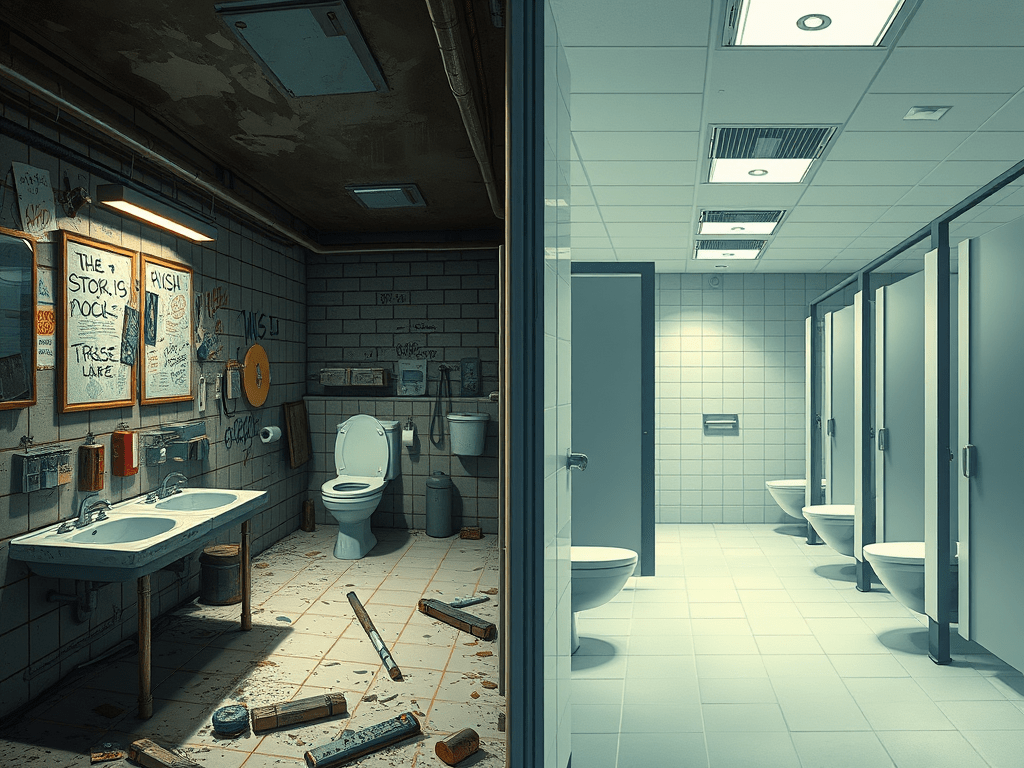
Businesses spend a lot of money on sleek logos, fancy lobby furniture, and crafting the perfect mission statement to tell you who they are. I’m sure those things are important, but as someone with a tiny bladder, I’ve had extensive exposure to the different bathrooms of America. I’ve become a bit of a connoisseur of the Haus of Porcelain Throne, which has led me to a theory:
You can tell a lot about a business by how well they take care of their bathrooms.
If well-maintained, the business is likely paying attention to the details in all aspects of the business. If neglected, what else is the business neglecting?
Case Study #1: Buc-ees
Buc-ees is known for many things, but one of their biggest draws is their large and always-clean bathrooms. Everything really is bigger in Texas. There are several things about the way Buc-ees approaches their bathrooms that actually hint at good business practices.
- Respect for dignity: Most public restrooms have those awkward gaps in the stall doors that make eye contact a constant threat. Buc-ee’s invested more money than a typical business does to surround each of their 6,423 stalls with floor-to-ceiling walls and heavy-duty doors. It shows a level of respect toward their customers by doing more to ensure privacy.
- Dedicated bathroom crew: You almost never walk into a Buc-ee’s restroom without seeing an employee actively cleaning. They don’t just have a “check sheet” on the back of the door that some employee initials off (if at all) and they also pay them pretty well. It shows that they treat maintenance as a primary function of the business, not a secondary chore for an overworked cashier. Plus, when the dispensers are always full and the toilet paper always stocked, you prevented less frustrations among your customers.
- Green lights: Many locations have the red and green lights above the stalls to indicate whether the bathroom is occupied. It’s essentially a high-stakes parking garage for your dignity that eliminates awkward glancing under the doors, knocking, or jiggling handles.
- Location, location, location: Usually, putting the restrooms at the back of the store is a cheap retail trick to force you past the merchandise. But at Buc-ee’s, the location is a flex. They know you’ve been holding it for 40 more miles specifically because you trust their stalls more than your own home’s. Walking past the brisket smells and wall of ICEE machines isn’t a chore; it’s the appetizer. They’ve turned a basic human necessity into a destination event that justifies a five-minute hike through a sea of Beaver Nuggets.
Buc-ee’s didn’t just build a bathroom. They built an example of operational excellence.
Case Study #2: The Sketchy Gas Station Bathroom
Many gas stations treat the bathroom as a liability to be managed, not a service to be provided. These are the bathrooms you only go to because you absolutely have to. They are dirty, may be out of supplies, smelly, and you’re just hoping to come out of the experience as disease-free as you were when you entered. Here are some things it can also say about the business:
- Uninviting: When you have to ask a teenager behind a bulletproof glass window for a key attached to a 5-pound piece of scrap metal, it definitely doesn’t come across as inviting. What they fail to realize is that it also doesn’t invite me to make any other purchases.
- Neglected maintenance: A flickering fluorescent light, unstacked supplies, or a door that doesn’t quite lock signal that the business does not care about maintenance. Sure, it’s “just the bathroom,” but neglect is rarely contained to one room. If they’ve stopped caring about the lightbulbs you can see, what else is being neglected behind the scenes? Can you really trust they’re checking the expiration dates on the things you’re about to eat?
- Single-ply experience: If a business is trying to save $0.002 per visitor by using translucent toilet paper, you have to wonder where else they are cutting corners. Are they also skimping on safety protocols? Fresh ingredients? Proper training? If they are willing to save a few cents on two-ply or a functional latch, you can bet they are looking for ways to cut corners on your experience, too.
What Makes a Good Bathroom/Business?
Failing to invest in things that can make an experience better for the customer signals that money is the only bottom line. But here’s the irony: the businesses that treat the bathroom like an afterthought usually end up losing the very thing they’re chasing. When a customer walks out of a neglected restroom, they aren’t just thinking about the soap; they’re recalculating the value of the entire brand.
And this is why I think bathroom theory works. It’s not just about the bathrooms, but any part of a business that may be overlooked because the leaders don’t see it as a core part of their business. It could instead be the janky website that hasn’t been updated in a decade. Perhaps it’s a lack of transparent pricing. Or maybe it actually is the furniture in the lobby. But these are all things your customers see and relate back to your business. In the end, a business that doesn’t respect the small, unglamorous needs of its customers doesn’t actually respect the customer. When a company excels at something they could easily ignore, they are revealing their true character.
 Life Off-Label
Leave a comment