One thing among the many things to consider when choosing a pharmacy school is the extent to which a state is saturated with pharmacy schools. Whether you plan to practice in the same state or move to a different state after graduation, it would be good to know what states are more likely to have their markets flooded with new graduates each year.
Just looking at the number of pharmacy schools in each state does not tell the whole picture. Some states, like California, have a lot of schools. But they also have a lot of people. So what we really want to know is, how proportional is the number of schools to the state’s population?
I made a table where I compared the number of pharmacy schools in a state to the state’s population (obtained from 2020 Census data), presented in order from least saturated to most saturated. To get the saturation “index,” I divided the population by the number of schools, and then divided that by 1 million. Therefore, the number represents how many million people exist per school, with a higher number indicating less saturation.
The formula: (State Population / Number of Schools) / 1,000,000
A few things to keep in mind:
- This table does not account for satellite campus locations, only main campus location
- Several states do not have a pharmacy school (at least a main campus) – VT, NH, AK
- This map only counts schools, it does not take into account class size
But, again, we’re just looking at some data for fun, so let’s see what we’ve come up with!
| State | Population | # CoP | Area | Per Pop |
| Minnesota | 5,706,494 | 1 | 225163 | 5.706494 |
| New Jersey | 9,288,994 | 2 | 22591 | 4.644497 |
| Washington | 7,705,281 | 2 | 184827 | 3.852641 |
| Florida | 21,538,187 | 6 | 170304 | 3.589698 |
| Arizona | 7,151,502 | 2 | 295234 | 3.575751 |
| Michigan | 10,077,331 | 3 | 250493 | 3.35911 |
| Puerto Rico | 3,285,874 | 1 | 9104 | 3.285874 |
| Utah | 3,271,616 | 1 | 219653 | 3.271616 |
| Texas | 29,145,505 | 9 | 696241 | 3.238389 |
| Nevada | 3,104,614 | 1 | 286380 | 3.104614 |
| Missouri | 6,154,913 | 2 | 181533 | 3.077457 |
| Kansas | 2,937,880 | 1 | 213100 | 2.93788 |
| Colorado | 5,773,714 | 2 | 269837 | 2.886857 |
| Georgia | 10,711,908 | 4 | 153909 | 2.677977 |
| North Carolina | 10,439,388 | 4 | 139390 | 2.609847 |
| New York | 20,201,249 | 8 | 141300 | 2.525156 |
| Alabama | 5,024,279 | 2 | 135765 | 2.51214 |
| California | 39,538,223 | 16 | 423970 | 2.471139 |
| Louisiana | 4,657,757 | 2 | 135382 | 2.328879 |
| Indiana | 6,785,528 | 3 | 94321 | 2.261843 |
| Kentucky | 4,505,836 | 2 | 104659 | 2.252918 |
| Oregon | 4,237,256 | 2 | 255026 | 2.118628 |
| New Mexico | 2,117,522 | 1 | 315194 | 2.117522 |
| Maryland | 6,165,129 | 3 | 32131 | 2.055043 |
| Oklahoma | 3,959,353 | 2 | 181195 | 1.979677 |
| Wisconsin | 5,893,718 | 3 | 169640 | 1.964573 |
| Pennsylvania | 13,002,700 | 7 | 119283 | 1.857529 |
| Idaho | 1,839,106 | 1 | 216699 | 1.839106 |
| Illinois | 12,812,508 | 7 | 149998 | 1.830358 |
| Connecticut | 3,605,944 | 2 | 14357 | 1.802972 |
| Massachusetts | 7,029,917 | 4 | 27336 | 1.757479 |
| Virginia | 8,631,393 | 5 | 110862 | 1.726279 |
| Ohio | 11,799,448 | 7 | 116096 | 1.685635 |
| Iowa | 3,190,369 | 2 | 145746 | 1.595185 |
| Arkansas | 3,011,524 | 2 | 137733 | 1.505762 |
| Mississippi | 2,961,279 | 2 | 125443 | 1.48064 |
| Hawaii | 1,455,271 | 1 | 28311 | 1.455271 |
| South Carolina | 5,118,425 | 4 | 82931 | 1.279606 |
| Tennessee | 6,910,840 | 6 | 109247 | 1.151807 |
| Rhode Island | 1,097,379 | 1 | 3144 | 1.097379 |
| Montana | 1,084,225 | 1 | 381154 | 1.084225 |
| Nebraska | 1,961,504 | 2 | 200520 | 0.980752 |
| South Dakota | 886,667 | 1 | 199729 | 0.886667 |
| North Dakota | 779,094 | 1 | 183108 | 0.779094 |
| Washington, D.C. | 689,545 | 1 | 177 | 0.689545 |
| Maine | 1,362,359 | 2 | 91646 | 0.68118 |
| West Virginia | 1,793,716 | 3 | 62755 | 0.597905 |
| Wyoming | 576,851 | 1 | 253348 | 0.576851 |
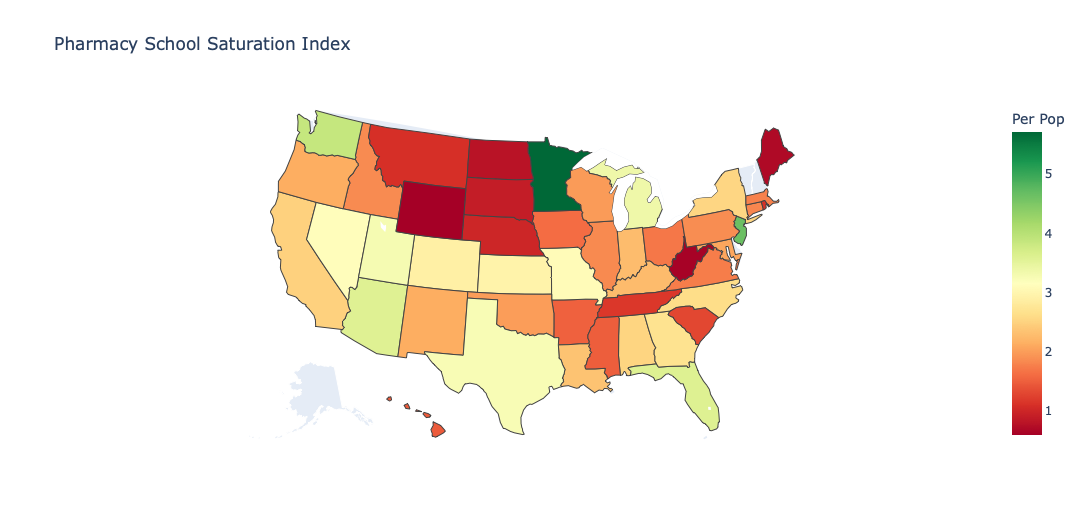
Creating a Heat Map
As informative as the above table is, I think it helps when we have some visual cues. I took the above results and created a heat map where green = less saturated and red = more saturated.
(I recently started learning Python, so I’m pretty proud of how this turned out!)
Looking Ahead
To see how this may play out in the future, I also looked at HRSA’s 2031 workforce projections for pharmacists. Nationally, there is expected to be shortage of about 18,000 pharmacists. However, this will be felt in some states more than others. Of the top 5 most saturated states (according to my index), North Dakota, West Virginia, Washington DC, and Wyoming are also projected to have a surplus of pharmacists by 2031. Of the top 5 least saturated states, Washington and Florida are also projected to have a shortage. Of course, this assumes no new schools open in that time, but it appears the trend of pharmacy schools constantly opening has slowed significantly from where it used to be 10-20 years ago.
To what extent does my saturation index correspond to a shortage in 5 years? Let’s look at that, too.
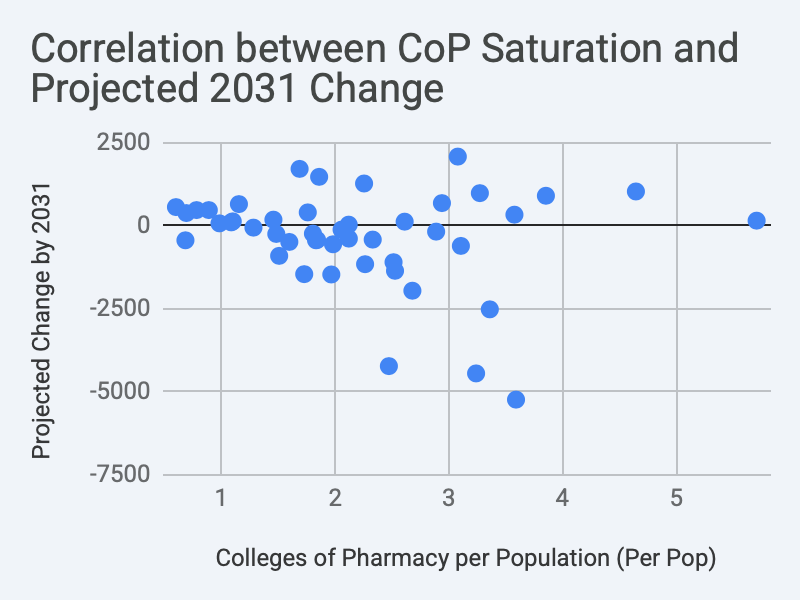
It’s not as compelling as we were hoping. As we can see, any correlation between my saturation index and future workforce projections is quite weak. I’ll definitely need to do some more investigating and data gathering to see if I can make my index stronger. Probably class size will be a good one to incorporate if I am able. But that will be for another post!
 Life Off-Label
Leave a comment